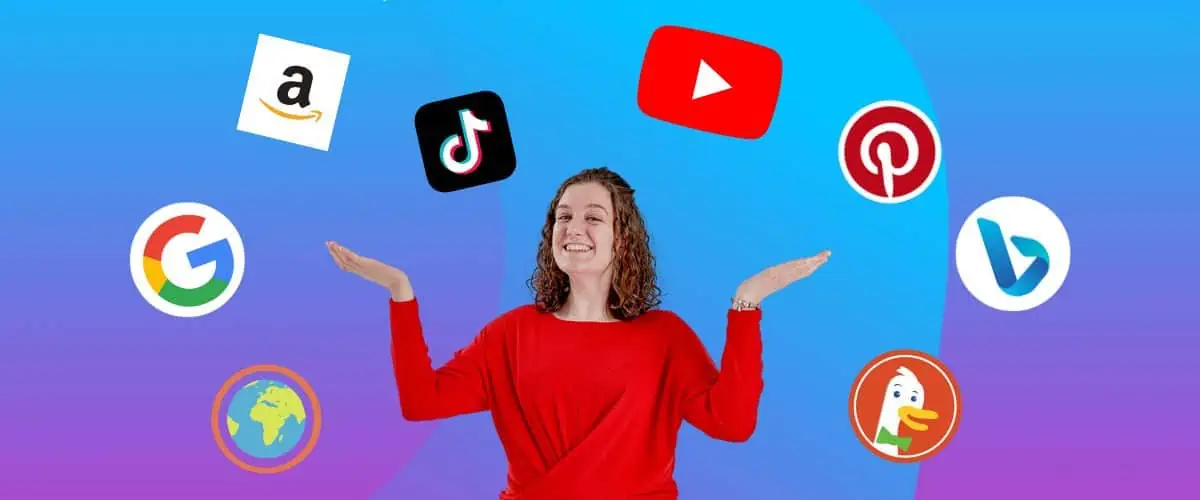
When you think of SEO, you might just think about ranking well on Google. And you’d be right that this is what a huge majority of the conversations about SEO are about! But search goes beyond this, and there are many other search engines – both traditional and non-traditional – where SEO plays a significant role in getting our businesses, products and services seen.
Why do we focus so much on Google? My hunch is that there are two reasons behind this. The first – and most relevant – is that Google still has the largest market share globally of the traditional search engines. In July 2023, Google held 83.5% of the global desktop search engine share, according to Statista. What’s interesting – and what should be a clear argument for diversification – is that this stake has dropped significantly from 91.5% at the end of 2018.
The other reason I think Google holds so much allure for SEO is the sheer volume of information that Google provides for people trying to improve how their sites perform. Whilst most search engines provide guidelines, Google’s information is extensive – including its’ Quality Rater Guidelines, Google SEO Office Hours, the Search Central blog and much more. The complexity of Google’s algorithms and the amount of detail to absorb keeps us all on our toes. And the payoff of cracking it – given the massive market share – can be enormous for the businesses we work with.
But there are many sites beyond Google which are a search engine in their own right. If our target customers are there, it’s a site where we should also be trying to perform well in search results. And whilst each search engine functions differently, the basic principles of SEO that apply to ranking well in Google also benefit SEO work across other search engines too.
To start off, let’s take a look at some of the other search engines you might want to target:
Other traditional search engines such as Bing, Yahoo and DuckDuckGo.
There used to be a joke that most of the searches performed on Bing were people looking for Google…but it’s been gaining in popularity in recent years. Back in November 2018 it held a 3.4% market share, but it’s now up to 9.2% as of July 2023. In no small part, this is down to Bing being the default search engine on Microsoft owned products. If users don’t have a particular preference (or technological know-how), they often stick with the default. Bing has also got ahead of the game by incorporating GPT-4 into search, giving users a new way to experience the web.
Alongside search engines like Bing and Yahoo!, there are some more niche search engines which lean into people’s personal values:
- DuckDuckGo, which is geared towards privacy and doesn’t use tracking in the same way as many other search engines. DuckDuckGo has grown from a 0.05% market share in 2015 to 0.77% in July 2023, and will likely continue to grow in popularity as more people become concerned about how their data is tracked and sold online.
- Ecosia, a B corp which puts 100% of ad profits into environmental projects worldwide, the majority of which involve planting trees. Again, it’s touted as being a privacy-focused search engine.
How to rank in these search engines:
Many of the core principles for ranking on Google also apply to other traditional search engines, although each has its own algorithm (or in the case of smaller search engines, sometimes piggybacks off another database for results). General concepts include:
- Submit your website sitemap via Bing Webmaster tools. Both Yahoo! and DuckDuckGo use data from this, so submitting through Bing will also update other search engines. Ecosia uses Bing or (with consent), Google.
- Genuine, high-quality backlinks help to demonstrate authority.
- Keywords are still important. If you’re targeting a specific search engine, it’s helpful to check the guidance for this. Most use Natural Language Processing (NLP) which helps to understand the context behind a search – however if it’s not as advanced on a certain platform, you may need to use the exact keyword in headings and subheadings (but still don’t be tempted to use an exact-match keyword too many times throughout the page).
- Bing takes into account your social media presence as an authority metric – so if you have a large and engaged following, this is likely to help boost your website presence too.
Youtube
YouTube is the second largest search engine on the planet with almost 113 billion visits in October 2023 and more than 500 hours of video uploaded every minute.
YouTube was bought by Google in 2006, and videos on the platform also frequently appear in Google search results pages – but YouTube also has it’s own algorithm for searches made on the platform.
How to rank on YouTube:
We have a specific edition focusing on YouTube SEO coming up very soon with Chris Edwards of award-winning YouTube channel, HowtoAV.tv. A couple of quick tips include:
- Posting consistently – make sure that the schedule you pick is sustainable for the long term.
- Using your target keywords in tags, titles and descriptions
- Building a strong subscriber base. This is a key metric that helps to demonstrate authority.
- Keeping people watching and engaging with your video. Engagement metrics such as watch time, thumbs up, comments and subscribe show that your video is engaging and helpful for viewers, which means it’s likely to be shown to more people.
Make sure you don’t miss our YouTube SEO edition of Get to Know SEO by clicking here to subscribe to the newsletter!
TikTok
TikTok’s still seen as the new kid on the block, but it was originally launched in China back in 2016 and internationally a year later – so we’re already 6 years in to this journey. According to research by Rise at Seven, TikTok is taking some of the informational search traffic (such as ‘how to…’) from Google, with topics such as cars, money advice, fashion and gaming getting searched more frequently on TikTok than Google.
How to rank on TikTok:
- Post consistently – TikTok recommends that creators publish a video 1-4 times a day. As with YouTube, you need a process to scale content creation without making your schedule unsustainable in the long term.
- Be authentic. This is a platform which thrives on relatable content. Look for ways you can get involved in conversations and make the most of trends whilst staying true to your brand. There’s no pressure to create high-budget, polished videos here – most TikTok videos feel really natural and informal, and can be a great way to show the fun and human side of your business.
- Look for relevant keywords and hashtags on the platform, and use those in your content.
- Grab attention with the start of your caption – longer captions will get cut off by the ‘see more’ button.
- Create engaging content and keep testing to find what works best for your brand. User engagement (such as likes, shares, follows or watching a video in full) show the algorithm which content each user likes. This can help videos get shown in the ‘For You’ page and help you reach more of your target audience.
Amazon
Amazon has become a key platform for buying and selling worldwide, and the significant competition for traffic and clicks means that SEO is an essential part of getting products sold. Amazon’s sales revenue has dramatically increased over the past 20 years, hitting almost $514 billion in 2022. It’s become a go-to platform for people looking for plenty of choice, low prices and convenience, and the huge sales potential makes it an attractive option for many businesses looking to sell high volumes of B2C products.
How to rank on Amazon:
- Focus on conversion. The number of sales a product has made plays a big part in Amazon rankings – it wants to promote products that it knows are going to sell well. So don’t let your focus be drawn entirely by ranking in search when you start out – make sure that there’s plenty in place to support conversion too.
- As usual, keywords play a significant role. You can use keywords in the product name and description – but also take advantage of the back end of a listing, which lets you add in additional relevant keywords which might be used in searches. Filling in as much detail as you can about your product – e.g. what it’s made of, whether it’s a unisex item of clothing or male/female, whether it can be used indoors, outdoors or both etc, can help to include more relevant information and keywords within your product listing, which can help you show up for more searches.
- Reviews don’t play as big a role in rankings as they used to, as they were getting widely spammed. But it’s still really important to collect reviews from genuine customers where you can – this can also help with conversion.
- Include multiple high-quality images within your listing, showing your product from different angles and being used in real life. When people can’t shop in person, images and videos help to replicate some of that in-person shopping experience and helps the decision making process (and therefore conversion).
- The delivery speed and price also play a part in where a product is shown in results, so keep an eye on what competitors are doing and see whether you can adjust or improve these elements for users.
Posts made on Pinterest generally have a longer lifespan than those made on other social networking sites, such as Facebook or Instagram. This can help generate long-term website traffic from users browsing for ideas and inspiration. It’s an option worth looking at for businesses who can demonstrate what they do in a visual way.
How to rank on Pinterest
- Include your target keywords within Pin names and descriptions and on your About page.
- Categorisation is a big part of Pinterest. When you create a board, think about the purpose of each one – highly targeted boards can appeal to a specific user need.
- Image optimisation is essential on this platform. There are different dimensions you can use – take the time to decide which layout works best for the purpose of your post.
- Images need to be high quality, eye-catching and designed with Pinterest in mind. Text overlays and bold titles can work well to grab attention, and photos should be well-focused and great quality.
Other sites to consider
Depending on your industry, there may be other sites that form part of your customer journey and where SEO could help you can more traction. For example, it’s possible to optimise listings on Booking.com and TripAdvisor to help your business get found by more people. If sites like this are key to your customer journey, spend some time looking up the SEO guidelines for those specific sites and implementing what you can (or hiring someone to do it for you!)
Some general tips for ranking on these sites:
- Make sure you’re doing keyword research for each specific platform or site, rather than sticking to the keywords you’ve researched for Google. Use keywords and relevant, attention grabbing content in your listing titles and descriptions, and across your overall profile where relevant.
- Look for more opportunities to use keywords in additional fields such as displaying ameneties people may be searching for.
- Positive reviews are often taken into account to some degree. Reviews with some detail of a first-hand experience (rather than just ‘Great!’) generally have more impact. Don’t create fake reviews – platforms are clamping down on this practice and low-quality reviews are often obvious to a potential customer.
- Include multiple high-quality images to show different aspects of your business and give customers a sense of what to expect when purchasing/booking.
- Include links to other sites such as your website and social media profiles where appropriate. For platforms which take authority elsewhere into account, this can help to boost your profile.
How do I incorporate these other search engines into my SEO strategy?
1. Work out where your target audience are searching
An early step in any SEO strategy should be working out where your audience spend time online. This is unlikely to include just one search engine, which is why having a multi-channel approach is helpful for most businesses.
There will be some obvious places – for example, people looking for a hotel are very likely to use a booking website as part of the customer journey – but they might also use social media or Google to get a sense of the location, or search for a hotel they’ve already heard of.
If you’re unsure which search engine(s) you should be targeting, you can use Glimpse, which looks at trending searches across the web and highlights where people are searching for your topic or product/service categories.
2. Think about the customer journey and how different search engines fit into this
Taking fashion and beauty as an example: these products are doing really well on TikTok, so you might choose to target this as a key channel. This can be backed up with ‘traditional SEO’ for people who’ve heard of you via word-of-mouth and are searching for the brand online.
3. Look at how your keywords map across these channels
Using the beauty example above, you might want to target broader keywords on TikTok to aid discovery, using hashtags and trends to show up for those topics.
If a website was used as a secondary channel alongside this, your highest priorities might be your brand name and product names/categories as this will help you show up for searches from people who’ve heard of your brand or product. If you want your website to also capture attention further up the marketing funnel, you’d also want to include more research around discovery- and comparison-phase keywords.
4. Embrace a multi-channel approach
Approaching SEO as a multi-channel approach can help you to understand more about your customer journey and build authority across different online profiles and websites. Make the most of your overall brand presence by linking sites and profiles together when you can, and by using a consistent brand name, logo and messaging to create a consistent web presence.
Targeting keywords and search intents across different search engines can help you to reach a wider audience, meeting your customers where they search and creating content that meets their needs. This can not only help you gain more traction, but also helps with building awareness of and trust for your brand.
Need some help developing a multi-channel SEO strategy? Get in touch via 📨 hello@heyyou.digital or 📞 0115 990 2779 to have a chat about how we can work together.
Want more tips like this?
Sign up to the Get to Know SEO newsletter for SEO knowledge, updates and ideas every Friday.